
T20 Strategy and Analytics
A Deep Tactical Analysis Ahead of Lotus Cup 2026 BHU vs MY
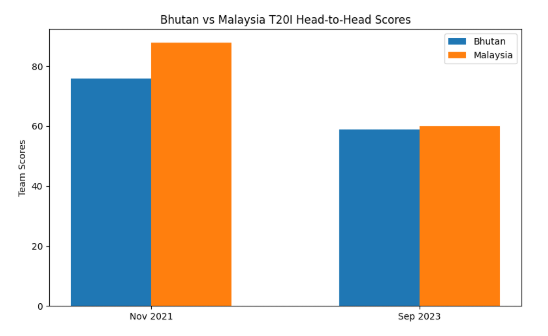
The Lotus Cup 2026 is shaping up to be a defining moment for emerging women’s T20 cricket in Asia, with Bhutan taking the field against a more seasoned Malaysia side. While Malaysia has historically held the upper hand in their previous encounters, the volatility of T20 cricket ensures that every over, every delivery, and every tactical decision carries the potential to alter the course of the match. In their two official T20I clashes, Malaysia has won both, narrowly defeating Bhutan by 12 runs in the 2021 Asia Qualifier and chasing down Bhutan’s modest 59 in 2023 with eight wickets in hand.
These results highlight the disparity in experience and tactical maturity, yet the scores also reveal opportunities. Bhutan has shown flashes of tactical awareness and individual skill, particularly in spin bowling, indicating that disciplined execution and calculated aggression could challenge Malaysia’s dominance.


Bowling analysis reveals a stark contrast in depth and tactical planning. Malaysia’s bowlers employ a calculated mix of seamers and spinners with defined roles: seamers attack the stumps and exploit early swing during powerplays, while spinners control the middle overs with flight variation, pace changes, and targeted line and length to specific batters. In death overs, Malaysia relies on yorkers, slower balls, and wide-angle deliveries to suppress boundaries and increase dot-ball pressure. Bhutan’s bowling unit has promise, particularly with spin variations, but maintaining consistent pressure across 20 overs remains a challenge.
Projections suggest that to contain Malaysia, Bhutan must focus on building pressure in middle overs through dot-ball sequencing, adjusting field placements dynamically, and anticipating batter tendencies based on prior match data. Death-over scenarios indicate that even a single over yielding 15–20 runs could swing momentum decisively toward Malaysia, emphasizing the criticality of disciplined execution.
Fielding, fitness, and agility constitute another differentiator. Malaysia converts half-chances and maintains high boundary discipline, effectively translating defensive skill into tactical advantage. Bhutan has improved in recent years but still shows vulnerability in high-pressure moments, particularly in deep-field coverage and catching efficiency. In T20 terms, lapses here translate into immediate scoreboard consequences, reinforcing the need for meticulous fielding strategies, pre-planned catch positions, and rotational fielding responsibilities to manage batter aggression.
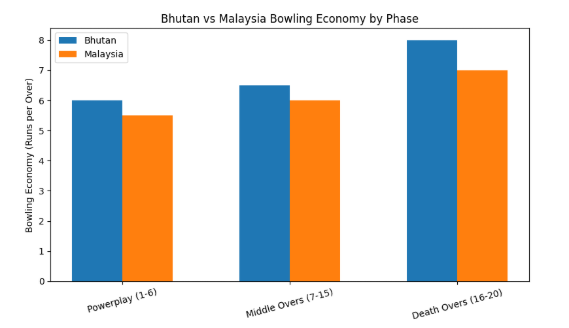
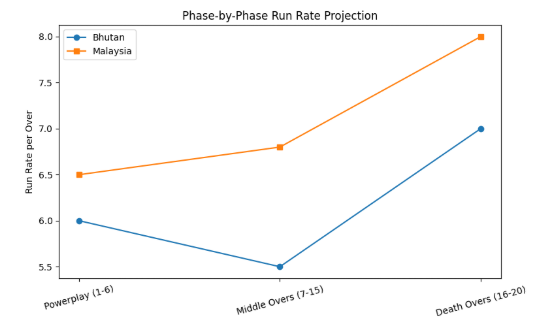
The phase-by-phase tactical simulation for the match suggests that the first six overs will define the early momentum. Malaysia is likely to implement controlled aggression with a focus on preserving wickets while exploiting scoring gaps, whereas Bhutan must aim for calculated scoring without incurring early losses. The middle overs, overs 7–15, will serve as the tactical pivot; Malaysia is expected to deploy mid-innings variations and targeted bowling, while Bhutan’s optimal response would involve rotating the strike, stabilizing partnerships, and using spinners to exert pressure and induce errors. The final death overs, overs 16–20, are projected to be high-leverage moments. Malaysia’s death bowling precision and ability to execute pre-planned variations make run containment likely, whereas Bhutan’s success depends on precise placement, disciplined shot selection, and exploiting any deviation in line or pace from Malaysia’s bowlers.
Beyond statistics and strategy, the Lotus Cup 2026 represents a laboratory for tactical evolution in women’s cricket. Malaysia brings experience, structural depth, and consistency, while Bhutan embodies rapid growth, adaptability, and the potential to leverage T20 volatility. The nature of the format amplifies variance; a short, high-impact sequence of events — a double-wicket over, a 20-run surge, or a sudden batting collapse — can redefine the match narrative. Historical trends suggest that Bhutan’s chances hinge on minimizing unforced errors, stabilizing partnerships, and executing tactical plans under pressure, while Malaysia’s challenge is to maintain control, enforce pressure across all phases, and adapt dynamically to Bhutan’s emerging strategies.